Small crab into the corals @Mafia Island - Tanzania ©Andrea Pompele All Rights Reserved

Small crab into the corals @Mafia Island - Tanzania ©Andrea Pompele All Rights Reserved
Visualizzazione post con etichetta elephants. Mostra tutti i post
Visualizzazione post con etichetta elephants. Mostra tutti i post
sabato 13 febbraio 2016
Africa, the mother land: Tanzania. UNA GRANDE AVVENTURA MI ASPETTA/ A GREAT ADVENTURE IS WAITING FOR ME
Lo so che volete che io vi parli delle Udzungwa mountains e della loro incredibile bellezza e ricchezza.
E il momento in cui ricomincerò a scrivere sul blog arriverà presto non preoccupatevi.
Al momento però sto organizzando la prossima avventura che richiede un certo impegno e una notevole quantità di lavoro e di tempo a disposizione, mi perdonerete perciò se non vedrete molti articoli e post e foto o video sul blog.
Potrete seguire però la nuova avventura e la sua preparazione su questa pagina facebook Africa Conservation Adventure e sui vari indirizzi dei social medias che vi daranno una bella panoramica di ciò che stiamo per fare. UNA GRANDE AVVENTURA, di quelle da ricordare, con uno scopo ben preciso, proteggere la natura, gli elefanti, i rinoceronti, i leoni ed in generale tutta la wildlife africana.
Non potete perdervela, non potete non divertirvi seguendola, non potete far finta di niente. Seguiteci e sostenete la causa
Ci vediamo presto sul web
FACEBOOK https://www.facebook.com/africaconservationadventure/
TWITTER https://twitter.com/AdventureLifePr
INSTAGRAM https://www.instagram.com/andrewbigdaddy/
#africaconservationadventure
#Adventure #Never #Ends
ENGLISH VERSION
I know you want me to tell you about the Udzungwa mountains and their incredible beauty and richness.
The moment I'll start to write again on the blog will come back soon don’t worry.
At the moment, I'm planning the next adventure that requires some effort and a considerable amount of work and time, so forgive me if you do not see many articles and posts and photos or videos on the blog.
But you can follow the new adventure and its preparation on this facebook page Africa Conservation Adventure and the various addresses of the social medias that will give you a nice overview of what we are doing. A GREAT ADVENTURE to remember, with a purpose to protect nature, elephants, rhinos, lions and in general all the African wildlife.
You cannot miss it, you cannot not having fun by following it, you cannot wait. Teh time is now. Join and sustain the cause.
See you soon on the web
FACEBOOK https://www.facebook.com/africaconservationadventure/
TWITTER https://twitter.com/AdventureLifePr
INSTAGRAM https://www.instagram.com/andrewbigdaddy/
#africaconservationadventure
#Adventure #Never #Ends

venerdì 25 settembre 2015
Non c'è avventura senza Video - There's no Adventure without videos: RESCUE ELEPHANTS VS LIONS PRIDE ATTACKING BABY ELEPHANT
Sesto video preparato per voi dalla Tanzania: RESCUE ELEPHANTS VS LIONS PRIDE ATTACKING BABY ELEPHANT
Grazie mille a Dismass che ha condiviso questa clip con me.
Buona visione
Se vi è piaciuto questo video allora potreste essere interessati a vedere anche questi altri:
WILD WILD SAFARI EXPERIENCE @Mdonya Old river Camp - Ruaha
MDONYA'S MONKEYS MADNESS
BIG MIGRATION - SAFARI ANTS
IL VIAGGIO
DIVING ADVENTURES
DUGONGO
NUOTANDO CON I DELFINI PT II
NUOTANDO CON I DELFINI
SOSSUSVLEI NAMIB DESERT PANORAMIC FLIGHT
SANDWICH HARBOUR 4X4 NAMIB DESERT
WILD WILD SAFARI EXPERIENCE @Mdonya Old river Camp - Ruaha
MDONYA'S MONKEYS MADNESS
BIG MIGRATION - SAFARI ANTS
IL VIAGGIO
DIVING ADVENTURES
DUGONGO
NUOTANDO CON I DELFINI PT II
NUOTANDO CON I DELFINI
SOSSUSVLEI NAMIB DESERT PANORAMIC FLIGHT
SANDWICH HARBOUR 4X4 NAMIB DESERT
Here the SIXTH video made for you from Tanzania: RESCUE ELEPHANTS VS LIONS PRIDE ATTACKING BABY ELEPHANT
Thank you very much Dismass for sharing with me this clip
If you like this video, maybe you can watch these others:
WILD WILD SAFARI EXPERIENCE @Mdonya Old river Camp - Ruaha
MDONYA'S MONKEYS MADNESS
BIG MIGRATION - SAFARI ANTS
THE TRIP
DIVING ADVENTURES
SWIMMING WITH DOLPHINS
SOSSUSVLEI NAMIB DESERT PANORAMIC FLIGHT
SANDWICH HARBOUR 4X4 NAMIB DESERT
A NIGHT DRIVE WITH LIONS
mercoledì 27 maggio 2015
Africa, the mother land: Tanzania. Il viaggio / The trip
Dar es Salaam è un casino.
Una città enorme, sembra
infinita, con un traffico pazzesco e un sacco di gente che fa di tutto, ma
proprio di tutto, ovviamente per strada. È una metropoli africana insomma. Non diversa
dalle altre ma nello stesso tempo unica. Sono stato lì 3 giorni e mi è
piaciuta, ma ovviamente non era la mia meta.
La mia destinazione era Mdonya
Old River Camp, nel Ruaha National Park, attualmente il parco nazionale più
grande e il più wild al centro sud della Tanzania.
 |
| The long way road from Dar es Salaam to Iringa - Tanzania - ©Andrea Pompele All Rights Reserved |
Ci sono arrivato, ma ci ho messo
un po’. Non perché sia particolarmente distante, solo 550 km da Dar es Salaam,
e di solito è servito da aerei tipo Chessna o simili, con l’airstrip presente
all’interno del parco, quindi per coloro che si recano in safari è piuttosto
semplice arrivare.
Non per me.
Io sono partito da Dar es Salaam
in macchina, un veicolo aperto, da game drive, e un pick up carico di
materiale. Partenza ore 5:30 del mattino, almeno questo era il programma, ma
abbiamo avuto qualche contrattempo. Per fortuna era domenica, quindi in realtà
non c’era molto traffico rispetto al solito, ma se comparate il lunedì mattina
in Tangenziale a Milano o sul Grande Raccordo Anulare di Roma, si potrebbe dire
tranquillamente il doppio. Non male eh?
 |
| The long way road from Dar es Salaam to Iringa - Tanzania - ©Andrea Pompele All Rights Reserved |
In città è pieno di gente che fa
jogging, ma non come lo faremmo noi, gruppi di 50 persone insieme di diversa
età che si ritrovano per correre la mattina in giro per la metropoli,
meraviglioso vederli che attraversano la strada ognuno con una maglietta
diversa, ma senza quelle tecnicissime scarpe, t-shirt e pantaloncini
antisudore. Costeggi alcuni slum, non sono proprio bidonville, direi piuttosto
quartieri nati per caso che si arrampicano su per le colline, senza alcun
progetto di sviluppo edilizio, sovrapopolati, senza fognature ovviamente o
strade vere e proprie tra baracche improvvisate e tetti di lamiera. Ovviamente
la gente si attrezza al meglio e non manca proprio nulla, c’è anche la palestra
di quartiere, con pesi e corsi, c’è anche il crossfit, e ho notato una palestra
di boxe, dove mi sarei infilato volentieri a tirar due pugni ad un sacco, sapete
com’è, istinto.
 |
| The long way road from Dar es Salaam to Iringa - Tanzania - ©Andrea Pompele All Rights Reserved |
Comunque di per sé è un viaggio
bellissimo. Su una strada asfaltata A7 che collega la città di Dar a quella di
Iringa, una delle strade principali, perfettamente tenuta a dirla tutta, con un
sacco di camion e un sacco di auto, ma senza incidenti ed un traffico
scorrevole. Si attraversano diversi villaggi, ognuno con la sua tipica
confusione e il suo tipico ordine, mi stupisco sempre un po’ perché ogni volta
che capito in un villaggio africano sulla strada principale c’è sempre questo
casino imperante, come se tu fossi costantemente al mercato, ma tutto procede
senza intoppi, tutto scorre liscio e senza fretta, ma continuo, almeno questa è
la mia impressione.
 |
| The long way road from Dar es Salaam to Iringa - Tanzania - ©Andrea Pompele All Rights Reserved |
Abbiamo passato il Parco
Nazionale di Mikumi, la strada ci passa in mezzo, e abbiamo visto zebre, gnu, elefanti,
giraffe etc…abbiamo fatto colazione, più un pranzo a dire la verità, in un
posto tranquillissimo con un sacco di gente. Comunque anche qui abbiamo avuto
qualche intoppo: la polizia ci ha fermato 6 volte, hanno i rilevatori di
velocità sempre puntati e anche se il tuo tachimetro indica 45 km/h loro ti
mostrano 70 km/h magari di un’altra macchina e tu non puoi, o comunque è molto
meglio, non contestare. Ad un certo punto, all’inizio delle montagne Udzungwa,
costeggiando l’omonimo Parco Nazionale, abbiamo avuto un problema tecnico con l’auto,
che ha deciso di fermarsi nel cuore delle stesse lontano da ogni possibile
villaggio. Il meccanico ha provato ad aggiustare il “contrattempo” ma abbiamo
dovuto passare gran parte della notte all’aperto, in mezzo alla foresta. Capita
in Africa. Beh ragazzi, una figata!
 |
| The long way road from Dar es Salaam to Iringa - Tanzania - ©Andrea Pompele All Rights Reserved |
Una foresta bellissima,
verdissima, incredibilmente varia, me la sono proprio goduta. A parte il fatto
che faceva un freddo pazzesco, vi ricordo che IN AFRICA NON FA CALDO, almeno non in tutta l’Africa
e non in tutti i momenti della giornata. Siamo ripartiti ad una certa ora della
notte per arrivare ad Iringa di mattina presto. Ho riposato in una guest house
un paio di ore e dopo pranzo siamo ripartiti per il Ruaha.
 |
| Ruaha National Park's Gate - Tanzania - ©Andrea Pompele All Rights Reserved |
Ci ho messo due giorni ad
arrivare nel Parco, è stata impegnativa, ma immediatamente arrivato all’ingresso
dello stesso mi sono sentito come se fossi a casa, l’ambiente che preferisco
savana alberata a miombo. Baobab ovunque e paesaggi incredibili. Dall’ingresso
del Parco fino al campo ci vuole circa un’ora e mezza, si attraversa quasi
subito il fiume Ruaha, una pista bellissima in mezzo al bush. All’arrivo nel
campo ho incontrato subito gli elefanti che vivono nella zona intorno e spesso
all’interno dello stesso.
Un benvenuto meraviglioso, un
ottimo inizio direi.
 |
| Track in the bush - Ruaha National Park - Tanzania - ©Andrea Pompele All Rights Reserved |
Se vi è piaciuto questo articolo allora potreste essere interessati a lasciare un commento, oppure a leggere anche questi altri:
LA FINE DI UN'AVVENTURAl
ENGLISH VERSION
Dar es Salaam is a mess.
A huge city, it seems endless,
with a crazy traffic and a lot of people that does everything, absolutely
everything, obviously in the street. It
is an African metropolis in short. Not different from the others but at the
same time unique. I was there for three days and I liked it, but obviously it
was not my goal.
My destination was Mdonya Old
River Camp in Ruaha National Park, actually the largest national park in the south
center and the wildest of Tanzania.
I got there, but it took me a
while. Not because it is very far, just 550 km from Dar es Salaam, and it’s
usually served by aircraft Cessna type or similar, with the airstrip inside the
park, so for those who go on safari is quite easy to get.
Not for me.
I left from Dar es Salaam by car,
an open “game drive” vehicle and a pick up a full of material. Departure at
5:30 am, at least that was the plan, but we had some mishap. Luckily it was
Sunday, so really there was not much traffic than usual, but when compared on
Monday morning in a Milan main road or GRA of Rome, you could safely say twice.
Not bad eh?
In the city it’s full of joggers, but not as in Europe, everybody
alone, but groups of 50 people together with different ages who find themselves
in the morning to run around the city, wonderful to see them crossing the road
each one with a different t-shirt, but without those technical shoes, t-shirt
and anti sweat pants. You can see some slums, tehy are not properly shanty
towns, I would say quite neighborhoods born by chance that climb up the hills,
without any development project, overpopulated, without sewers or roads
obviously true of makeshift shacks and tin roofs. Obviously people will equip
the best and nothing is missing, there is also a neighborhood gym, with weights
and courses, there is also the crossfit, and I noticed a boxing gym, where I
would have put on willingly to pull two punches, you know, instinct.
However in itself it’s a
beautiful journey. On a paved road A7 that connects the city of Dar to Iringa,
along a main road, perfectly bound to be honest, a lot of trucks and a lot of
cars, but no accidents and traffic flowing. You go through different villages,
each with its typical confusion and its typical order, I am always astonished a
little because every time I arrive in an African village on the main road there
is always this mess prevailing, as if you were constantly at the market but
everything is going smoothly, everything runs smoothly and without hurry, but I
still, at least this is my impression.
We pass the Mikumi National Park,
the road passes in between, and we saw zebras, wildebeest, elephants, giraffes
etc ... we had breakfast, plus lunch to tell the truth, in a very quiet place
with lots of people. However, even here we had some difficulties: the police
stopped us 6 times, have always pointed speed detectors and even though your
speedometer shows 45 km / h they will show 70 km / h maybe another car and you
don’t or at least it is much better not to contest. At one point, at the
beginning of the Udzungwa Mountains, along the homonymous National Park, we had
a technical problem with the car, it decided to stop in the heart of the same,
away from every possible village. The mechanic tried to adjust the
"setback" but we had to spend most of the night in the open air, in
the middle of the forest. It happens in Africa. Well guys, pretty cool!
A beautiful forest, very green,
incredibly varied, I've just enjoyed. Apart from the fact that it was so crazy
cold, remember,IN AFRICA IT'S NOT HOT , at least not in the whole of Africa and not at all times of
the day. We left at a certain time of the night to get to Iringa early morning.
I rested in a guest house a couple of hours and after lunch we left for the
Ruaha.
It took me two days to get to the
park, has been challenging, but immediately arrived at the entrance of the
same, I felt like I was at home, the environment I prefer a wooded miombo savanna. Baobabs everywhere
and amazing sceneries. From the entrance to the camp it takes about an hour and
a half, almost immediately you cross the Ruaha River, a beautiful track in the
middle of the bush. Upon arrival in the camp I met immediately elephants living
in the area around and often within the same
.
A wonderful welcome, a good start
I think.
If you like this post maybe you can read also these ones:
THE END OF AN ADVENTURE
If you like this post maybe you can read also these ones:
THE END OF AN ADVENTURE
martedì 3 marzo 2015
Africa, the mother land: Egypt. Mr Dugongo
“Hey man, how was the excursion?”
“good, but no Andrea, no Dugong, it’s seems you are Mr. Dugongo”
I ragazzi mi prendono in giro così.
In effetti la cosa è strana, la
prima escursione che ho fatto quando sono arrivato in Egitto era proprio per
l’avvistamento del Dugongo, uno dei mammiferi marini più interessanti e
minacciati. E proprio in quell’occasione l’abbiamo avvistato, poi anche tutte
le altre volte è andata così, e devo dire di ritenermi fortunato. Non è molto
comune avvistarlo e con gli animali selvatici liberi una buona dose di fortuna
non fa male.
 |
| Dugong - SeaCow - Marsa Egla - Egypt ©Andrea Pompele All Rights Reserved |
Io e Ale ci siamo conosciuti in Italia, durante un corso di formazione e ci siamo capiti al volo, io non so stare fermo a far niente neanche se mi obbligano, ho una fame di scoprire e di conoscere che mi divora e lei ha una forte personalità e un sacco d’esperienza nel mondo del diving. Perciò abbiamo cominciato a legare immediatamente.
 |
| Dugong - SeaCow - Marsa Egla - Egypt ©Andrea Pompele All Rights Reserved |
Date a Cesare quel che è di
Cesare, e direi che il merito va tutto a lei, peraltro se lo merita.
Ma torniamo al nostro amico
Dugongo.
Il dugongo è un mammifero marino,
ma è l’unico cetaceo erbivoro. “Scusa non è che potresti spiegarti meglio? Come
al solito non si capisce niente…”, “adesso ci arriviamo”.
Appartiene all’ordine dei
Sirenidi, la parola deriva proprio dalle sirene perché in epoca antica era
stato confuso esse. Non a caso infatti possiede delle caratteristiche
particolari: una lunga coda con pinna caudale bilobata che muove lentamente, ma
molto efficiente, due pinne pettorali che vengono usate soprattutto per
ancorarsi al suolo, poi vedremo perché, più che per muoversi e la posizione
delle ghiandole mammarie decisamente inconsueta, il alto sul petto, cosicché da
assomigliare proprio ad un seno femminile.
Et Voilà la leggenda è fatta.
Et Voilà la leggenda è fatta.
 |
| Dugong - SeaCow - Marsa Egla - Egypt ©Andrea Pompele All Rights Reserved |
Ma il nostro Mr. Dugongo è unico nel suo genere, infatti mentre tutti gli altri cetacei, sia che si tratti di delfini (odontoceti) piuttosto che balene (misticeti) sono strettamente carnivori, lui è erbivoro.
Si nutre di una pianta marina che cresce soltanto in alcune baie (Marsa in arabo) in diverse parti del mondo, soprattutto in Mar Rosso. “piano, piano…piante marine? Vorrai dire alghe!” “no, no voglio dire proprio piante” si tratta di fanerogame marine che hanno un sistema radicale di ancoraggio al suolo, un fusto, delle foglie e fanno fiori emettendo polline, avendo una riproduzione sessuale proprio come le piante terrestri, ce n’è una anche nel mediterraneo si chiama Posidonia, ne avete mai sentito parlare?
 |
| Dugong - SeaCow - Marsa Egla - Egypt ©Andrea Pompele All Rights Reserved |
Nonostante non sia assolutamente
pericoloso per l’uomo e per niente aggressivo, bisogna comunque avere un certo
codice di comportamento quando si avvicina un esemplare. Primo, non toccarlo
(altrimenti vi stacco le mani) secondo non stargli troppo vicino e non troppo
addosso, lui sta sul fondo e voi in superficie a fare snorkeling, ma direi che
affollare troppo l’area non è cosa consigliabile potremmo disturbarlo e quindi,
non volendo, scacciarlo da casa sua. Oltretutto personalmente ho una regola,
che viene rispettata anche dai miei colleghi del diving, dopo circa un quarto
d’ora di osservazione si ritorna a riva e si cerca di far capire agli ospiti,
che sono fortunati ad aver avuto l’opportunità di vedere un animale in via
d’estinzione, e che può essere sufficiente così, non credete? È molto meglio
non disturbare troppo un animale, in modo da avere l’opportunità di rivederlo
in un’altra occasione piuttosto che scacciarlo. Possiamo godere della natura in
maniera diversa, più etica e a scopo conservazionistico, in modo migliore.
"Hey man, how was the excursion?" "Good, but no Andrea, no Dugong, it's Seems you are Mr. Dugong"
The guys tease me so.
 |
| Green Sea Turtle - Marsa Egla - Egypt ©Andrea Pompele All Rights Reserved
Se vi è piaciuto questo articolo allora potreste essere interessati a lasciare un commento, oppure a leggere anche questi altri:
IL PRIVILEGIO DI LAVORARE IN CIABATTE I DELFINI DI SATAYA |
ENGLISH VERSION
The guys tease me so.
Indeed, the strange thing is, the
first hike I did when I arrived in Egypt was just for the sighting of the
Dugong, one of the most interesting and threatened marine mammals. And on that
occasion we spotted, then also all the other times it went well, and I must say
I feel lucky. It’s not very common to spot him and with wild animals free a
good amount of luck doesn’t hurt
Primarily because the project I'm following (THE PRIVILEGE TO WORK IN FLIP FLOPS) at TGI DIVING MARSA ALAM is giving me the opportunity to live in nature
continuously, to see amazing places and to make discoveries and adventures are
always new and full of emotion. And for this I have to thank the person who
conceived the project and that follows directly, one I don’t hesitate to call her
a great woman with a temper but she looks far away and things to be done are
done: Alessandra Sicilia.
Me and Ale we met in Italy, during
a training course, and we understand each other immediately, I can not sit
still and do nothing even if you force me, I have a hunger to discover and to
know that consumes me and she has a strong personality and a lot of experience
in the world of diving. So we started to bond immediately. Practically a
criminal crew, because if we decide one thing, there's no doubt that we do not
do it. She and her husband Lollo are wonderful people, and they have that spark
in their eyes that tells you "hey I have a good look at my face? I'm not a
nerd! "And they are not able to stand still. So understand that when
Alexandra called me and asked me to put together the project and leaving, I
could possibly say no? I would have been stupid, and between 1000 flaws that I
have, for sure stupid I’m not.
Give to Caesar what is Caesar's,
and I would say that the credit goes to her, however, she deserves it.
But back to our friend Dugong.
The dugong is a marine mammal,
but it’s the only cetacean herbivore. "I'm sorry can you explain? As usual
do not understand anything ... "" Now we get there. "
It belongs to the Sirenia order,
the word derives from the mermaids because in ancient times it has been
confused with them. Not by chance that owns the particular characteristics: a
long tail with bilobate tail fin that moves slowly, but very efficient, two
pectoral fins which are mainly used for anchoring to the ground, then we will
see why, rather than to move and the position of the mammary glands very
unusual, the upper chest, so as to resemble their own to a female breast.
Et
Voilà the legend is made.
But it’s not the only mammal that
has a "breast" in the same position with human beings, however,
common to all primates, and you know what are the other two? I tell you, the
Elephant and the Hyrax. Unexpected true? Actually they are closely related to
an evolutionary point of view, that is, they have a common ancestor, not very
far, land based and small, who then thanks to evolutionary pressures was
"differentiated" in different animals, whales, elephants and nice
hyrax that share several qualities, including how to make sounds in space
called echolocation and some ways of communication. But our Mr. Dugong is
unique, in fact, while all other cetaceans, whether it be of dolphins (toothed whales)
rather than whales (baleen whales) are strictly carnivores, it’s herbivorous.
It feeds on a marine plant that grows only in some bays (Marsa in Arabic) in
different parts of the world, especially in the Red Sea.
"Slowly, slowly
... marine plants? You mean seaweeds = algae! "" No, no I mean plants”
seagrasses that have a root system to
anchor to the ground, a stem, leaves and flowers are emitting pollen, having a
sexual reproduction just like land plants, there is one in the Mediterranean
also called Posidonia, have you ever heard about? Our friend Dugong divides the
meal with green sea turtles in these seagrass prairies where it digs little
pathways radially, very similar to those found in the bush that we call
"game tracks", the "dugong tracks", grazing with a certain
hunger this tender grass. And it needs to eat a lot! It can easily grow up to 4
m per 400 kg and is a calm and relaxed giant and without natural enemies. A
part of the man of course.
It’s a mammal and therefore depends on the surface
and from the air to breathe every 8 minutes it must return to the surface to
take a breath of air, and does so without too many worries.
Although not absolutely dangerous
to humans and not at all aggressive, you really have to have a certain code of
behavior when approaching a specimen.
First, do not touch it (otherwise I will
deadlift your hands) according not keep up too close and not too much above
him, he is on bottom and you on surface to snorkel, but I would say that the
area is not to crowd too, advisable thing could disturb him and then, not
wanting, cast it out from its house.
Besides, I personally have a rule, which
is respected by my colleagues of the diving center, after about fifteen minutes
of observation we come back to land trying to make it clear to the guests, we
are lucky to have had the opportunity to see an endangered animal, and that may
it’s enough, don’t you think?
It’s better not to disturb an animal, so you have
the opportunity to see it again another time rather than drive it out. We can
enjoy nature in a different way, more ethical and conservation oriented, in the
best way.
If you like this post, maybe you could read these others:
THE PRIVILEGE TO WORK IN FLIP FLOPS
SATAYA'S DOLPHINS
If you like this post, maybe you could read these others:
THE PRIVILEGE TO WORK IN FLIP FLOPS
SATAYA'S DOLPHINS
lunedì 22 dicembre 2014
Africa, the mother land: Namibia. IL FIUME DEGLI ELEFANTI PT III
Ritornando verso il Damaraland camp si attraversa un’ansa del letto del fiume che compie una curva e si apre in una zona priva di alberi, dominata da una vegetazione a prateria.
Scorgo da lontano una sagoma a me ormai piuttosto familiare: struzzi. Sono un bel gruppo, saranno una ventina, con maschi in guerra tra loro per effettuare le parate nuziali, combattono e si mostrano in splendida forma, con viso, collo e zampe rosa scuro tendente al rosso e un sacco di energia da vendere. Si affrontano in quella che nel mondo dell’etologia viene definita “arena” uno spazio non per forza circolare dove gli esemplari maschi delle specie avicole si combattono e si mostrano alle femmine per essere scelti. La scelta è sempre femminile e gli struzzi non fanno eccezione.
Avete presente il balletto che compiono nel film di animazione "Fantasia" della Disney? Dove ballano con le “ippopotame”? Beh le piroette che compiono sono proprio quelle di un ballerino di danza classica, vorticando su se stessi per poi fermarsi di colpo e correre da una parte all’altra del palcoscenico. L’osservazione della natura ci può essere d’aiuto e se guardiamo il cartone animato, che peraltro io ho sempre amato fin da piccolo, riconosciamo i perfetti movimenti di questi splendidi animali rivisitati in chiave di balletto, che in realtà è già contenuto nel loro stesso comportamento.
Meraviglioso non credete? Si vede che i disegnatori e registi avevano avuto l’occasione di poter vedere proprio questo spettacolo naturale, perché di questo si tratta.
Proseguiamo un po’ e seguendo le tracce sulla sabbia, incontriamo un altro gruppo di elefanti. Dunque ricapitolando siamo a 25 + 13 + 30 = 68 direi non male in una sola giornata eh? Ma questo è merito della guida… ”vola basso Pompele e non te la tirare, che sei solo un novellino in fondo” “giusto, giusto, non esageriamo, sono proprio un novellino in fondo”.
 |
| Ostriches (Struthio camelus) - Damaraland - Namibia ©Andrea Pompele All Rights Reserved |
Avete presente il balletto che compiono nel film di animazione "Fantasia" della Disney? Dove ballano con le “ippopotame”? Beh le piroette che compiono sono proprio quelle di un ballerino di danza classica, vorticando su se stessi per poi fermarsi di colpo e correre da una parte all’altra del palcoscenico. L’osservazione della natura ci può essere d’aiuto e se guardiamo il cartone animato, che peraltro io ho sempre amato fin da piccolo, riconosciamo i perfetti movimenti di questi splendidi animali rivisitati in chiave di balletto, che in realtà è già contenuto nel loro stesso comportamento.
Meraviglioso non credete? Si vede che i disegnatori e registi avevano avuto l’occasione di poter vedere proprio questo spettacolo naturale, perché di questo si tratta.
 |
| Male Ostriches fighting (Struthio camelus) - Damaraland - Namibia ©Andrea Pompele All Rights Reserved |
Questa volta gli elefanti camminano decisi tutti in una direzione, in una specie di fila indiana, si chiamano Game Tracks, gli animali sociali seguono sempre un individuo che si mette in testa e li guida in una direzione,
 |
| Lappet-faced Vulture (Torgos tracheliotus) - Damaraland - Namibia ©Andrea Pompele All Rights Reserved |
Li seguo, so dove stanno andando, la matriarca li sta guidando al di là della montagna, e così ho l’occasione di mostrare ai miei ospiti un sentiero che essi usano per valicare le montagne.
“Come scusa, valicare le montagne?” “sì sì, proprio quello, aspetta che ci arriviamo”.
Gli elefanti del deserto possono arrivare a pesare circa 6 tonnellate, i maschi adulti, mentre le femmine sono più “leggere”, diciamo. Sembra impossibile ma sono agilissimi e riescono letteralmente a scalare le montagne, possono passare in stretti che assomigliano ai nostri sentieri alpini, alcuni di questi anche a strapiombo con una facilità sorprendente, da vere guide alpine adottano la stessa tecnica di camminata che ho io in montagna: piano seguendo il proprio passo, senza accelerare o rallentare, ma senza fermarsi mai. In 20 minuti sono sul costone della montagna e attraversano il piccolo passo. Vi siete mai chiesti come ha fatto Annibale ad attraversare le Alpi per marciare verso Roma? Beh ha sfruttato la caratteristica di questi splendidi ed evolutissimi animali, capaci di adattarsi a qualsiasi habitat e condizione, da quelle più “classiche” di savana, a quelle più estreme del deserto e delle montagne.
Meraviglioso. Semplicemente meraviglioso.
“Come scusa, valicare le montagne?” “sì sì, proprio quello, aspetta che ci arriviamo”.
Gli elefanti del deserto possono arrivare a pesare circa 6 tonnellate, i maschi adulti, mentre le femmine sono più “leggere”, diciamo. Sembra impossibile ma sono agilissimi e riescono letteralmente a scalare le montagne, possono passare in stretti che assomigliano ai nostri sentieri alpini, alcuni di questi anche a strapiombo con una facilità sorprendente, da vere guide alpine adottano la stessa tecnica di camminata che ho io in montagna: piano seguendo il proprio passo, senza accelerare o rallentare, ma senza fermarsi mai. In 20 minuti sono sul costone della montagna e attraversano il piccolo passo. Vi siete mai chiesti come ha fatto Annibale ad attraversare le Alpi per marciare verso Roma? Beh ha sfruttato la caratteristica di questi splendidi ed evolutissimi animali, capaci di adattarsi a qualsiasi habitat e condizione, da quelle più “classiche” di savana, a quelle più estreme del deserto e delle montagne.
Meraviglioso. Semplicemente meraviglioso.
Faccio il giro delle due colline vulcaniche che prima ho chiamato montagne, “ah ecco perché le hanno scalate,
sono solo collinette” “mica tanto, sono piuttosto difficili da affrontare credimi, anche se non sono tanto alte come le Alpi” e ci ritroviamo in un'altra piana dominata da erba. Gli elefanti stanno scendendo verso la pianura e si dispongono come sempre con i cuccioli al centro del gruppo a difesa e protezione. Un individuo, non ho riconosciuto se era maschio o femmina, ero piuttosto lontano, si arrampica letteralmente sul pendio davanti a noi per andare a divorarsi un cespuglio che cresceva sul quel lato, una meraviglia vederlo salire con una leggerezza impensabile per un animale delle sue dimensioni, e questo conferma il fatto che non hanno assolutamente bisogno di sentieri, loro i sentieri se li fanno da soli.
 |
| Elephants - Damaraland - Namibia ©Andrea Pompele All Rights Reserved |
 |
| Sunset - Damaraland - Namibia ©Andrea Pompele All Rights Reserved |
Ve l’avevo detto no, che mi era entrato nel sangue?
Domattina andremo in cerca dei leoni e dei rinoceronti, ma per oggi abbiamo fatto il pieno.
Se vi è piaciuto questo articolo allora potreste essere interessati a lasciare un commento, oppure a leggere anche questi altri:
Africa, the mother land: Namibia. IL FIUME DEGLI ELEFANTI PTII
Africa, the mother land:Namibia. IL FIUME DEGLI ELEFANTI PT I
Africa, the mother land: Namibia. HOW IS IT? VEEEEERY VERY HOT
English version
Africa, the mother land: Namibia. IL FIUME DEGLI ELEFANTI PTII
Africa, the mother land:Namibia. IL FIUME DEGLI ELEFANTI PT I
Africa, the mother land: Namibia. HOW IS IT? VEEEEERY VERY HOT
English version
Returning to Damaraland camp we cross a bend in the riverbed that makes a curve and opens in an area free of trees, dominated by prairie vegetation.
I see from a distance a silhouette quite familiar to me: ostriches. They are a great group, will be average twenty, with males at war with each other to perform the nuptial parades, fight and show in great shape, with the face, neck and legs reddish pink and a lot of energy to spare. Facing off in what in the world of ethology is called "arena" a space not necessarily circular where the males of the avian species fight and show themselves to be chosen by females. The choice is always feminine and ostriches are no exception.
You know the ballet performed in the Walt Disney animated movie "Fantasia"? Where they dance with the hippos? Well, pirouettes are those of a ballet dancer, twisting on himself and then stop suddenly and run from one side to the other of the stage. The observation of nature can help, and if we see the cartoon, which in fact I have always loved since childhood, we recognize the perfect movements of these beautiful animals' twist ballet, which in fact is already contained in their behaviour. Wonderful don't you think? Designers and directors had the opportunity to see just this natural show.
We continue a while and following the tracks on the sand, we meet another herd of elephants. So in average we have 25 + 13 + 30 = 68 I could say: "not bad in one day" But this is about the guide ... "Pompele fly down, you're just a rookie" "right, right, I'm just a rookie"
This time all the elephants are walking in one direction, in a kind of single line, called Game Track. Social animals always follow an individual who lead them in a direction, digging paths that they constantly repeat, no matter if they are herbivores or carnivores, even lions do this, minimizing the energy consumption and the possibility to disperse the group always keeping eye contact with the one in front of them. In this way, they are also able to defend themselves from predators. In this case the Game Tracks become Elephant's Highways, because they are objectively bigger and better drawn.
I follow them, I know where they are going, the matriarch is leading them beyond the mountains, and so I have the opportunity to show my guests the path they use to cross the mountains. "They cross the mountains?" "Yes, yes, just that, expect that we get there."
The desert elephants can weigh about 6 tons, adult males, while females are "lighter". It seems impossible but they are very agile and can literally climb mountains with astonishing ease, may move in narrow that resemble our mountain's trails, some of these also overhanging. They use the same technique of an Alpine mountain guide, the same that I use to walk in the mountains: slowly following your step, without speeding up or slowing down, but without ever stopping. In 20 minutes they are on the side of the mountain and across the small pass. Have you ever wondered how did Hannibal crossed the Alps with War Elephants to march to Rome? Well, he exploited the characteristics of these beautiful and very advanced animals, able to adapt to any habitat and condition, from the most "classic" savannah, to the most extreme desert and mountain.
Wonderful. Simply wonderful.
I turn around the two volcanic hills that before I called mountains, "ah that's why they climb, they are just hills" "not so, they're quite difficult to deal with, believe me, even if they are not so high as the Alps" and we are in another plain dominated by grass, the elephants are coming down to the plain and have usually calfs at the center of the group for the defense and protection. An individual, I did not recognize if it was male or female, I was pretty far away, climbs literally on the slope in front of us to go to devour a bush growing on that side, a wonder to see him come up with a lightness unthinkable for an animal of its size, and this confirms the fact that they have absolutely no need of paths, their make paths by themselves.
While even this group moves away we decided to return to the tented camp and take the road that leads to Damaraland camp, meanwhile, we spot Oryx and Springboks and we taste the last hour of light in the bush in one of the most beautiful and amazing area that I have ever seen. Land of contrasts and beauty, light and dark, of mountains and plains, elephants and men. I told you, that I had entered the blood?
Tomorrow morning we will go searching for lions and rhinos, but for today it's enough.
If you like this post, you can comment or maybe you can read these ones:
Africa, the mother land: Namibia. HOW IS IT? VEEEEERY VERY HOT
Africa, the mother land: Namibia. HOW IS IT? VEEEEERY VERY HOT
giovedì 18 dicembre 2014
Africa, the mother land: Namibia. IL FIUME DEGLI ELEFANTI PT II
Il gruppo degli elefanti si nutre indisturbato all'interno del corso del fiume.
E' incredibile osservare gli elefanti, mi lasciano sempre stupito e affascinato, ho scattato centinaia di fotografie e ogni volta riescono a stupirmi, sono animali di una bellezza antica e devastante, molto pericolosi se non ci si comporta adeguatamente, e molto delicati se invece li si lascia in pace. Un contrasto meraviglioso, adatto alla terra dove ci troviamo, il continente africano.
In genere il gruppo rimane abbastanza unito.
Anche se divagano di albero in albero e si spostano di qualche decina di metri, sono sempre vicini e attenti. Non sembrano considerarsi più di tanto, ma rimangono sempre in comunicazione visiva gli uni con gli altri, ad una attenta osservazione si può percepire una coesione visiva netta. Comunicano soprattutto con gli infrasuoni e quando decidono di andare, o meglio la matriarca decide di andare, tutto il branco si sposta con lenta, almeno nella maggior parte dei casi, determinazione.
Mica poi tanto lenta comunque, sembrano camminare con calma, ma in pochi secondi sono già molto al di là delle nostre previsioni. Quando corrono possono essere imprevedibili e devastanti, purtroppo ho perso un amico in Mozambico a causa di una carica di elefanti improvvisa. Filippo era un ricercatore, di quelli bravi e aveva molta esperienza, ma si è trovato in una situazione estrema e senza possibilità di difendersi a piedi. Mi viene sempre in mente lui ogni volta che cerco gli elefanti.
Ma tornando a noi, "Grazie, meno male, stavi cominciando a metterci un po' di ansia, oltre che un'infinita tristezza." " Eh a chi lo dici..."
Il gruppo si muove. E si muove dapprima lentamente. Io cerco di posizionare il Land Rover per osservare una femmina con il suo cucciolo in modo da non disturbarli e non voglio restare per troppo tempo, bisogna avere rispetto e dedizione, oltre che mettersi in sicurezza. Mentre sto facendo manovra, un altro 4X4 si posiziona dietro di noi, impedendomi la visuale. Il solito problema: sarebbe meglio non ci fossimo o per lo meno che l'intelligenza di ognuno ci permetta di non ostacolare l'altro, ma
non sempre è così.Mi passa davanti un'altra femmina a pochi metri di distanza, con un cucciolo piccolo e un fratellino più grande, che si mostra parecchio interessato al Land Rover. Talmente interessato che avanza rapidamente verso di noi. la femmina si gira di scatto, il piccolo non si accorge di nulla, va beh, è un piccolo, deve esplorare, ed è davvero buffo e tenero vedere che prosegue goffo e veloce senza una meta precisa. Il fratello più grande non cede interesse e continua, è a qualche metro e non posso muovermi, indietro non posso andare, la macchina dietro di me mica si sposta, figuriamoci, e fare manovra non è né veloce, né pratico, né tanto meno efficace. Decido di stare fermo e intimo ai miei ospiti nella maniera più dolce e democratica che contraddistingue i miei modi signorili in certe situazioni, di stare tranquilli, non agitarsi e per favore fare silenzio.
"See come no? e noi dovremmo crederci?" "Chiedete ai miei ospiti! Uff, poca fiducia nelle mie capacità democratiche eh?"
Per fortuna sono stranieri. Olandesi una coppia, inglesi le altre due. E mi ascoltano.
Il giovane si avvicina, con la proboscide tocca lo specchietto e poi il mio braccio, immobile sulla portiera. Una sensazione indescrivibile, morbida e decisa. essa esplora, per una manciata di secondi, mi hanno riferito, che a me sono sembrati 5 minuti, la mia pelle. Mi annusa, mi palpa, mi fa rizzare i peli delle braccia e d'improvviso si gira e se ne va. La madre, sempre ferma, non ha tolto lo sguardo dal suo cresciutello piccolo, e per fortuna non si è mossa. Ospiti ammutoliti, emozione nelle vene scorre sotto forma di adrenalina, i muscoli sono pietrificati e senti un calore lungo il corpo che ti ha reso praticamente una stufa.
Lascio passare il branco intero e do un'occhiataccia alla guida dietro di me, che più tardi si scuserà di avermi messo in quella situazione. Gli ospiti non parlano ma sono visibilmente emozionati. Beh non è da tutti i giorni in effetti.
Più tardi ho analizzato bene la situazione: ho fatto la scelta giusta. Se avessi tentato di muovere il veicolo, l'elefante avrebbe potuto spaventarsi ed attaccarmi, se mi fossi agitato idem, mentre era semplicemente curioso di sapere chi fossimo, una curiosità tutta giovanile.
Ho riconosciuto le sue intenzioni.
Proseguiamo ad osservare il gruppo e lo osserviamo ancora un po' dopodiché ci dirigiamo al villaggio.
Il villaggio appartiene alla popolazione dei Riemvasmakers popolo deportato dal Sud Africa in seguito alle leggi sulla ricollocazione delle etnie durante il regime dell’Apartheid. È un villaggio piccolo e tranquillo, popolato da donne e bambini, gli uomini lavorano altrove e tornano periodicamente a far visita alle famiglie. Qui prendiamo un caffè e ascoltiamo la storia del popolo e del villaggio. E naturalmente vediamo un altro gruppo di elefanti attraversare la pianura dalle montagne e dirigersi alla pozza. Molto vicini al villaggio. Ogni tanto qualcuno di essi entra tra le case ma la popolazione non si scompone più di tanto, basta fare un po’ di rumore e avere la dovuta attenzione e i pachidermi se ne vanno senza danni…o quasi. Ogni tanto tirano giù qualche recinto e fanno scappare le capre, ma è accettabile.
E' incredibile osservare gli elefanti, mi lasciano sempre stupito e affascinato, ho scattato centinaia di fotografie e ogni volta riescono a stupirmi, sono animali di una bellezza antica e devastante, molto pericolosi se non ci si comporta adeguatamente, e molto delicati se invece li si lascia in pace. Un contrasto meraviglioso, adatto alla terra dove ci troviamo, il continente africano.
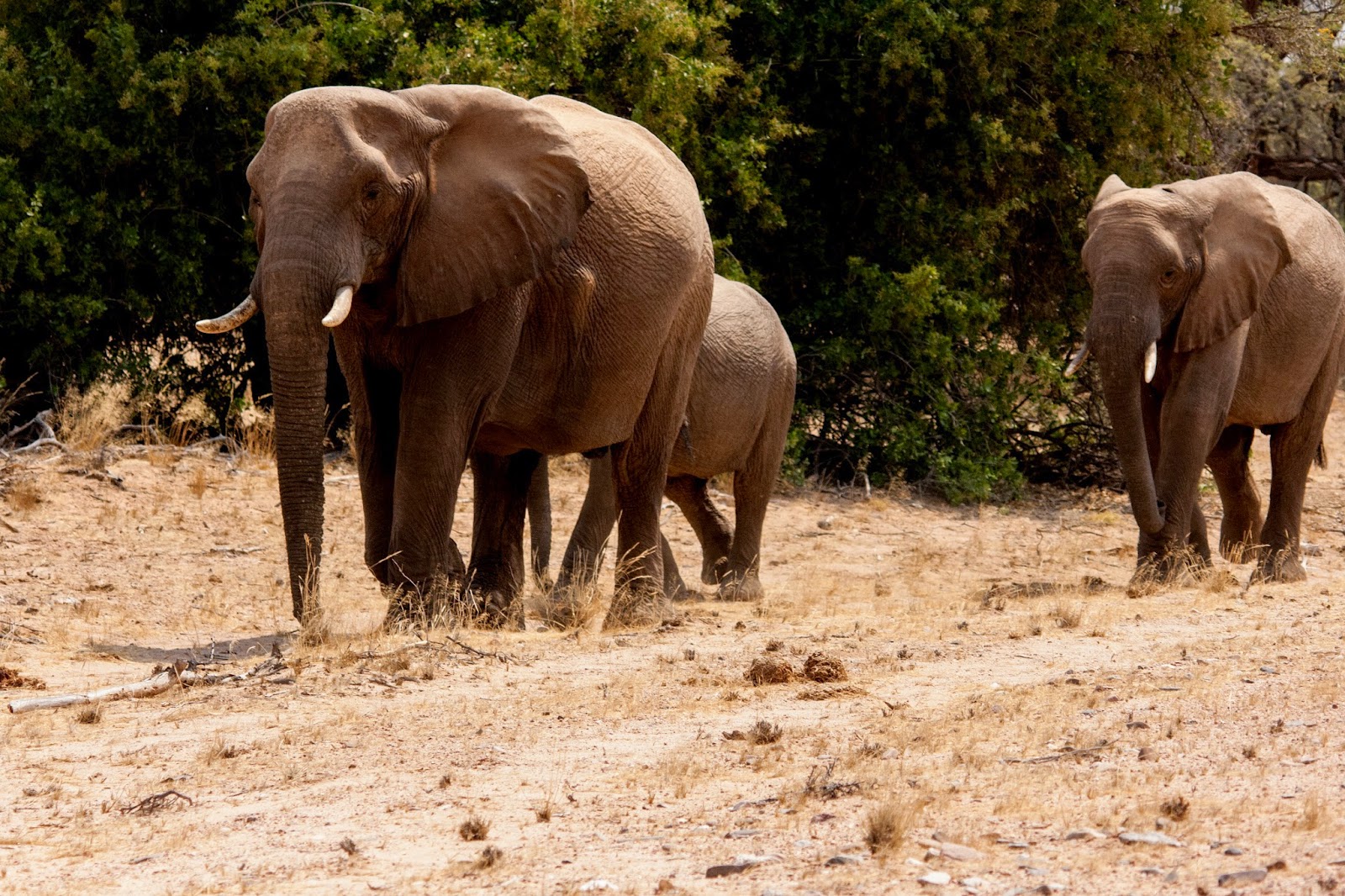 |
| Elephants in the riverbed - Damaraland - Namibia ©Andrea Pompele All Rights Reserved |
Anche se divagano di albero in albero e si spostano di qualche decina di metri, sono sempre vicini e attenti. Non sembrano considerarsi più di tanto, ma rimangono sempre in comunicazione visiva gli uni con gli altri, ad una attenta osservazione si può percepire una coesione visiva netta. Comunicano soprattutto con gli infrasuoni e quando decidono di andare, o meglio la matriarca decide di andare, tutto il branco si sposta con lenta, almeno nella maggior parte dei casi, determinazione.
 |
| Elephants foot - Damaraland Namibia ©Andrea Pompele All Rights Reserved |
Mica poi tanto lenta comunque, sembrano camminare con calma, ma in pochi secondi sono già molto al di là delle nostre previsioni. Quando corrono possono essere imprevedibili e devastanti, purtroppo ho perso un amico in Mozambico a causa di una carica di elefanti improvvisa. Filippo era un ricercatore, di quelli bravi e aveva molta esperienza, ma si è trovato in una situazione estrema e senza possibilità di difendersi a piedi. Mi viene sempre in mente lui ogni volta che cerco gli elefanti.
Ma tornando a noi, "Grazie, meno male, stavi cominciando a metterci un po' di ansia, oltre che un'infinita tristezza." " Eh a chi lo dici..."
Il gruppo si muove. E si muove dapprima lentamente. Io cerco di posizionare il Land Rover per osservare una femmina con il suo cucciolo in modo da non disturbarli e non voglio restare per troppo tempo, bisogna avere rispetto e dedizione, oltre che mettersi in sicurezza. Mentre sto facendo manovra, un altro 4X4 si posiziona dietro di noi, impedendomi la visuale. Il solito problema: sarebbe meglio non ci fossimo o per lo meno che l'intelligenza di ognuno ci permetta di non ostacolare l'altro, ma
 |
| Elephant's calf - Damaraland - Namibia ©Andrea Pompele All Rights Reserved |
"See come no? e noi dovremmo crederci?" "Chiedete ai miei ospiti! Uff, poca fiducia nelle mie capacità democratiche eh?"
Per fortuna sono stranieri. Olandesi una coppia, inglesi le altre due. E mi ascoltano.
Il giovane si avvicina, con la proboscide tocca lo specchietto e poi il mio braccio, immobile sulla portiera. Una sensazione indescrivibile, morbida e decisa. essa esplora, per una manciata di secondi, mi hanno riferito, che a me sono sembrati 5 minuti, la mia pelle. Mi annusa, mi palpa, mi fa rizzare i peli delle braccia e d'improvviso si gira e se ne va. La madre, sempre ferma, non ha tolto lo sguardo dal suo cresciutello piccolo, e per fortuna non si è mossa. Ospiti ammutoliti, emozione nelle vene scorre sotto forma di adrenalina, i muscoli sono pietrificati e senti un calore lungo il corpo che ti ha reso praticamente una stufa.
 |
| Elephants crossing - Damaraland - Namibia ©Andrea Pompele All Rights Reserved |
Più tardi ho analizzato bene la situazione: ho fatto la scelta giusta. Se avessi tentato di muovere il veicolo, l'elefante avrebbe potuto spaventarsi ed attaccarmi, se mi fossi agitato idem, mentre era semplicemente curioso di sapere chi fossimo, una curiosità tutta giovanile.
Ho riconosciuto le sue intenzioni.
Proseguiamo ad osservare il gruppo e lo osserviamo ancora un po' dopodiché ci dirigiamo al villaggio.
Una convivenza meravigliosa.
Come vi dicevo in precedenza (IL FIUME DEGLI ELEFANTI PT I), la comunità ha capito che la fauna selvatica è una risorsa e non una minaccia e la protegge come se fosse sua. E in parte lo è, è la loro terra, quindi è logico no? Dopo la sosta proseguiamo per quello che sarà il nostro pranzo sul corso del fiume e risaliamo verso il Damaraland camp. Qui trovo un albero molto grande di Ana tree (Faidherbia albida) e decido essere il nostro luogo ideale. mi fermo e faccio scendere i miei ospiti, dopo aver accuratamente osservato la zona. un'altra bella esperienza comincia, il River lunch, il pranzo sul letto del fiume. Non c'è niente di più bello che pranzare sotto un albero di Faidherbia albida all'aria aperta in the middle of the desert. Primo, secondo, contorno, formaggio (Blue Cheese, simile al Gorgonzola), carne secca (Biltong), salsicce essiccate sud africane (Droëwors), birra, vino, frutta, caffè ed...elefanti in lontananza che ci osservano.
Ad un certo punto ci vengono incontro e ci passano vicini, relativamente, e comunque avevo messo già via tutto e gli ospiti erano sul Land Rover, a terra rimanevo solo io.
 |
| Elephants - Damaraland - Namibia ©Andrea Pompele All Rights Reserved |
Ad un certo punto ci vengono incontro e ci passano vicini, relativamente, e comunque avevo messo già via tutto e gli ospiti erano sul Land Rover, a terra rimanevo solo io.
La sicurezza innanzitutto!
Se vi è piaciuto questo articolo allora potreste essere interessati a lasciare un commento, oppure a leggere anche questi altri:
Africa, the mother land: Namibia. HOW IS IT? VEEEEERY VERY HOT
ENGLISH VERSION
The group of elephants eats undisturbed along the river.
It's amazing to observe elephants, I'm always amazed and fascinated, I took hundreds of photographs and every time they amaze me, they're animals with an ancient and devastating beauty, very dangerous if you don't behave properly, and very delicate if you leave them in peace. A wonderful contrast, suitable to the land where we are, the African continent.
Typically the group remains fairly united.
Even if they ramble from tree to tree and move a few tens of meters, they're always close and careful. It's not seems that they consider each other that much, but they always remain in visual communication, under careful observation you can perceive a clear visual cohesion.
They communicate mostly with infrasounds and when they decide to go, or rather the matriarch decides to go, the whole herd moves with slow, at least in most cases, determination. Not that much slower, however, they seem to walk calmly, but in a few seconds they're already far beyond our expectations. When they run, they can be unpredictable and devastating, unfortunately I lost a friend in Mozambique due to a sudden charge of elephants. Filippo was a researcher, the good one and had a lot of experience, but he found himself in an extreme situation, and no opportunity to defend themselves by foot, he died. I always think of him every time I search for elephants.
But back to us, "Thank you, thank goodness, you were beginning to put in us a little anxiety, as well as an infinite sadness." "Eh you know .."
The group moves.
It moves slowly at first. I try to place the Land Rover to observe a female with her cub in a way to not disturb them and I don't want to stay too long, you have to have respect and dedication, as well as maintain yourself safe.
While I'm handling the car, another 4X4 ranks behind us, preventing the view. The usual problem: it would be better we did not, or at least that the intelligence of everyone let us not hinder the other, but it's not always possible.
Another female passes in front of us far just few meters, with a little puppy and a larger brother, which shows us to be quite interested in the Land Rover. So interested that advancing rapidly towards us. Female whirls, the baby does not notice anything, okay, he's young, he should explore, and it's really funny and tender to see how continues clumsy and fast aimlessly. The older brother does not yield interest and continues, he is few meters far and I cannot move, I cannot go back, the car behind me doesn't moves, and handle the car is neither fast, nor practical, nor effective . I decide to stay still and intimate to my guests in the most gentle and democratic way that distinguishes my manners, in certain situations, to be calm, do not get excited and please be quiet.
"We should believe it?" "Ask my guests! So, just little confidence in my democratic capabilities?"
Luckily they are foreigners. A Dutch couple, English the other two couples. They listen to me.
The young elephant approaches us, with its trunk touches the mirror and then my arm, still on the door. An undescribable feeling, soft and firm. It explores, for a handful of seconds, that to me seemed to be five minutes, .He smells my skin, touches my arm and suddenly turns around and walks away. The mother, always firm, did not remove her eyes from her grown-small, and luckily did not move.
Guests speechless, emotion flowing in the veins in the form of adrenaline, the muscles are petrified and felt a warmth along the body that made you practically a stove.
I let pass the whole herd and do a glare to the guide driving behind me, who later apologizes for putting me in that situation.
Guests don't speak but they are visibly excited.
Well in fact it's not common every day.
Later I analyzed the situation: I made the right choice. If I tried to move the vehicle or had fidget myself, the elephant could get scared and attack me, while he was simply curious to know who we were, a young curiosity.
I recognized his intentions.
We continue to observe the group and then we go to the village.
The village belongs to Riemvasmakers people, deported from South Africa following the laws on the relocation of ethnic groups during the Apartheid regime. It is a small and quiet village, populated by women and children, men work elsewhere and come back regularly to visit family.
Here we take a coffee and listen to the story of the people and the village. And of course we see another group of elephants cross the plains from the mountains and go to the waterhole. Very close to the village.
Occasionally one of them enters the village but the population don't do anything, just make a little noise and pachyderms leave no damage ... or almost. Sometimes they pull down the fence and make escape the goats, but it is acceptable.
A wonderful coexistence.
As I said earlier (THE ELEPHANT'S RIVER PT I), the community has realized that the wildlife is a resource and not a threat and protects it as his own property. And in fact it is, is their land, so it is logical don't you think?
After this break we go for the lunch on the riverbed along the road back to Damaraland camp. Here I find a very large Ana tree (Faidherbia albida) and I decide it will be our ideal. I stop and I moved down the car the guests after having carefully observed the area. Another beautiful experience begins: the River Lunch, lunch on the river bed. There is nothing beautiful as having lunch under a Faidherbia albida tree outdoor in the middle of the desert. First course, main course, cheese (Blue Cheese), Biltong, dried South African sausages (Droëwors), beer, wine, fruit, coffee and ... elephants watching us.
They pass next to us, relatively, and in any case I had already put everything into the car and guests were on the Land Rover, on the ground I was alone.
Safety first!
If you like this post, you can comment or maybe you can read these ones:
Africa, the mother land: Namibia. HOW IS IT? VEEEEERY VERY HOT
Se vi è piaciuto questo articolo allora potreste essere interessati a lasciare un commento, oppure a leggere anche questi altri:
Africa, the mother land: Namibia. HOW IS IT? VEEEEERY VERY HOT
 |
| Young bull - Damaraland - Namibia ©Andrea Pompele All Rights Reserved |
ENGLISH VERSION
The group of elephants eats undisturbed along the river.
It's amazing to observe elephants, I'm always amazed and fascinated, I took hundreds of photographs and every time they amaze me, they're animals with an ancient and devastating beauty, very dangerous if you don't behave properly, and very delicate if you leave them in peace. A wonderful contrast, suitable to the land where we are, the African continent.
Typically the group remains fairly united.
Even if they ramble from tree to tree and move a few tens of meters, they're always close and careful. It's not seems that they consider each other that much, but they always remain in visual communication, under careful observation you can perceive a clear visual cohesion.
They communicate mostly with infrasounds and when they decide to go, or rather the matriarch decides to go, the whole herd moves with slow, at least in most cases, determination. Not that much slower, however, they seem to walk calmly, but in a few seconds they're already far beyond our expectations. When they run, they can be unpredictable and devastating, unfortunately I lost a friend in Mozambique due to a sudden charge of elephants. Filippo was a researcher, the good one and had a lot of experience, but he found himself in an extreme situation, and no opportunity to defend themselves by foot, he died. I always think of him every time I search for elephants.
But back to us, "Thank you, thank goodness, you were beginning to put in us a little anxiety, as well as an infinite sadness." "Eh you know .."
The group moves.
It moves slowly at first. I try to place the Land Rover to observe a female with her cub in a way to not disturb them and I don't want to stay too long, you have to have respect and dedication, as well as maintain yourself safe.
While I'm handling the car, another 4X4 ranks behind us, preventing the view. The usual problem: it would be better we did not, or at least that the intelligence of everyone let us not hinder the other, but it's not always possible.
Another female passes in front of us far just few meters, with a little puppy and a larger brother, which shows us to be quite interested in the Land Rover. So interested that advancing rapidly towards us. Female whirls, the baby does not notice anything, okay, he's young, he should explore, and it's really funny and tender to see how continues clumsy and fast aimlessly. The older brother does not yield interest and continues, he is few meters far and I cannot move, I cannot go back, the car behind me doesn't moves, and handle the car is neither fast, nor practical, nor effective . I decide to stay still and intimate to my guests in the most gentle and democratic way that distinguishes my manners, in certain situations, to be calm, do not get excited and please be quiet.
"We should believe it?" "Ask my guests! So, just little confidence in my democratic capabilities?"
Luckily they are foreigners. A Dutch couple, English the other two couples. They listen to me.
The young elephant approaches us, with its trunk touches the mirror and then my arm, still on the door. An undescribable feeling, soft and firm. It explores, for a handful of seconds, that to me seemed to be five minutes, .He smells my skin, touches my arm and suddenly turns around and walks away. The mother, always firm, did not remove her eyes from her grown-small, and luckily did not move.
Guests speechless, emotion flowing in the veins in the form of adrenaline, the muscles are petrified and felt a warmth along the body that made you practically a stove.
I let pass the whole herd and do a glare to the guide driving behind me, who later apologizes for putting me in that situation.
Guests don't speak but they are visibly excited.
Well in fact it's not common every day.
Later I analyzed the situation: I made the right choice. If I tried to move the vehicle or had fidget myself, the elephant could get scared and attack me, while he was simply curious to know who we were, a young curiosity.
I recognized his intentions.
We continue to observe the group and then we go to the village.
The village belongs to Riemvasmakers people, deported from South Africa following the laws on the relocation of ethnic groups during the Apartheid regime. It is a small and quiet village, populated by women and children, men work elsewhere and come back regularly to visit family.
Here we take a coffee and listen to the story of the people and the village. And of course we see another group of elephants cross the plains from the mountains and go to the waterhole. Very close to the village.
Occasionally one of them enters the village but the population don't do anything, just make a little noise and pachyderms leave no damage ... or almost. Sometimes they pull down the fence and make escape the goats, but it is acceptable.
A wonderful coexistence.
As I said earlier (THE ELEPHANT'S RIVER PT I), the community has realized that the wildlife is a resource and not a threat and protects it as his own property. And in fact it is, is their land, so it is logical don't you think?
After this break we go for the lunch on the riverbed along the road back to Damaraland camp. Here I find a very large Ana tree (Faidherbia albida) and I decide it will be our ideal. I stop and I moved down the car the guests after having carefully observed the area. Another beautiful experience begins: the River Lunch, lunch on the river bed. There is nothing beautiful as having lunch under a Faidherbia albida tree outdoor in the middle of the desert. First course, main course, cheese (Blue Cheese), Biltong, dried South African sausages (Droëwors), beer, wine, fruit, coffee and ... elephants watching us.
They pass next to us, relatively, and in any case I had already put everything into the car and guests were on the Land Rover, on the ground I was alone.
Safety first!
If you like this post, you can comment or maybe you can read these ones:
Africa, the mother land: Namibia. HOW IS IT? VEEEEERY VERY HOT
Iscriviti a:
Post (Atom)